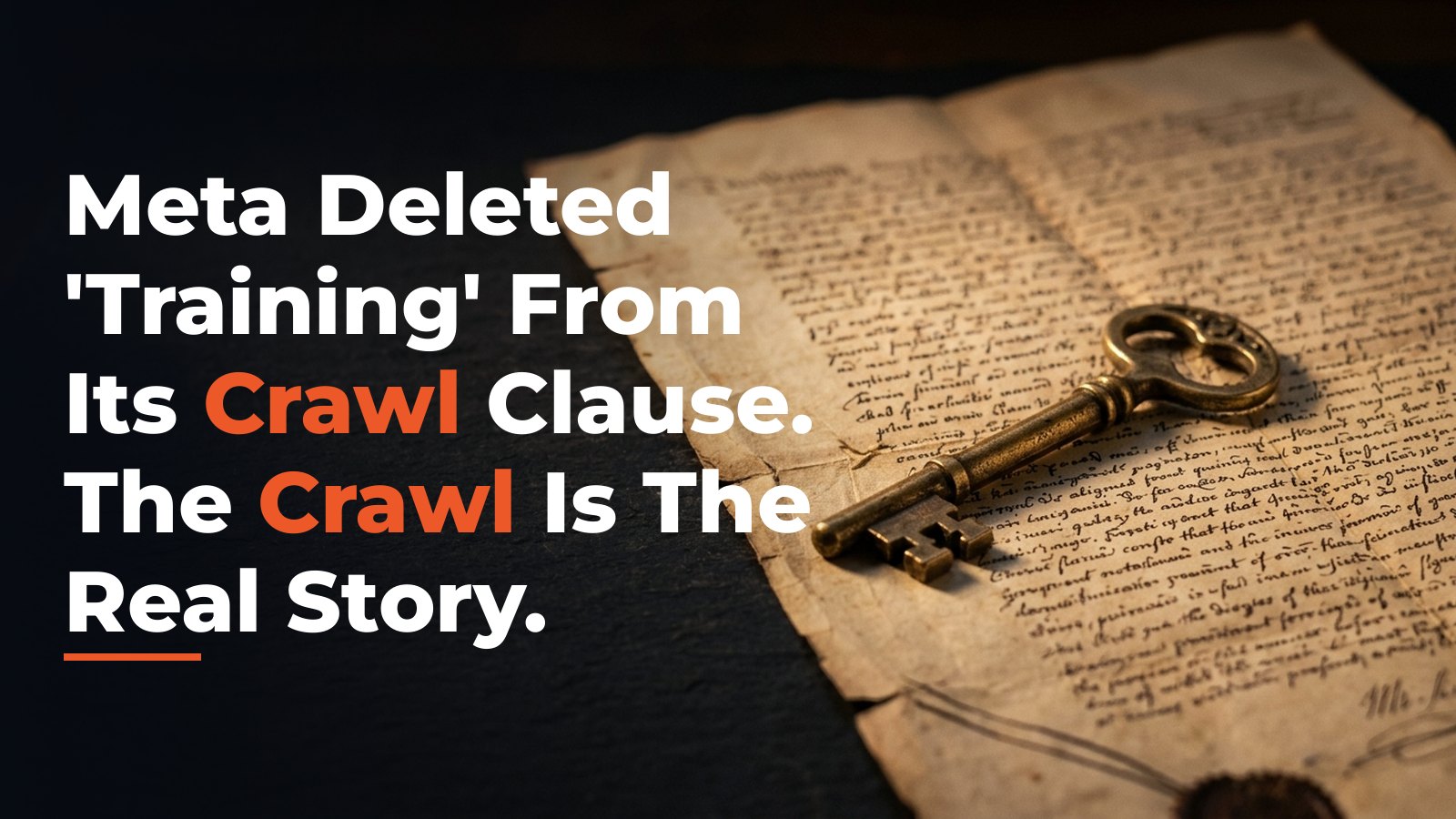
Meta Deleted 'Training' From Its Crawl Clause. The Crawl Is The Real Story.
Here is a belief I hear from smart people all the time: when a big platform softens the language in its terms of service, that is a win for the little guy. The outrage worked. They backed down. We can relax now.
I want to pressure test that, because Meta just gave us a clean little case study.
The story, in plain terms: Meta is updating its Commercial Terms, and it quietly removed the word "training" from the clause that gives it permission to crawl websites connected to its business users. The headlines framed it as a retreat. A concession. Meta stepped back from using your site to train its AI.
And maybe it did. But read the other half of that sentence. The permission to crawl is still there. It did not move. It did not shrink. The one word that got cut is the word everyone was angry about. The mechanism underneath it stayed perfectly intact.
That matters. Let me tell you why.
We keep reading the wrong word
When a company edits its terms, our instinct is to count what got deleted. We treat removal as retreat. Something left the page, so something must have been given back to us.
But terms of service are not written to be fair. They are written to be durable. The people drafting them are not trying to win an argument on social media. They are trying to protect a capability for the next ten years without you noticing which capability that is.
So the question is never "what did they remove?" The question is "what did they fight to keep?"
A company will happily give you the word it never needed, as long as you let it keep the sentence it was built on.
"Training" was always the emotional word. It is the word that makes a founder picture their life's work getting fed into a machine and spat back out as someone else's product. It is loud. It is easy to protest. It makes a great screenshot.
"Crawl" is the boring word. It sounds technical. It sounds like plumbing. Nobody starts a petition over plumbing.
And yet the crawl is the asset. The crawl is the access. Training is just one thing you might do once you have access. Remove the word and you have removed a single named use case. Keep the crawl and you have kept the door.
A key is worth more than any single room
Think about it like a building. Training your AI on my content is one room in that building. A valuable room, sure. But it is one room.
The crawl is the master key.
With the key, you can walk into that room today. You can walk into a different room tomorrow. You can walk into rooms that do not exist yet, that nobody has a name for, because the next use case has not been invented. The key does not care what the rooms are called.
So when Meta hands back the "training" room and keeps the master key, I do not read that as a company backing down. I read it as a company trading away a label it did not need in order to quiet the people who would have made noise about the key.
That is not cynicism. That is just how leverage works. You give up the thing that is costing you headlines and you hold onto the thing that is actually load bearing.
"Tied to business users" is doing a lot of lifting
Here is the part I want you to sit with, because it is the part that most of the coverage glides right past.
This permission is attached to sites connected to Meta's business users. Run ads. Use a business account. Plug into their tools in any of the ordinary ways that a modern company does. And somewhere in that relationship, you may be agreeing to let your own website get crawled under terms you accepted to do something completely unrelated.
Ask yourself a simple question. When was the last time you read the Commercial Terms before you boosted a post?
Right. Me neither, back when I used to assume somebody on the team had.
The most expensive thing you will ever agree to is the thing you agreed to while trying to do something else.
This is the quiet genius of bundling permissions into commercial relationships. You are not sitting down to negotiate data access. You are trying to launch a campaign, hit a deadline, get a product in front of people. The access clause rides along in the back seat, and it stays in the car long after the campaign is over.
So the real headline is not "Meta drops training." The real headline is "the crawl is still bundled into your business relationship, and now you feel better about it."
Why this is not a Meta problem
I do not want to make this about one company, because if you do that, you miss the pattern. And the pattern is the whole point.
Every major platform is converging on the same posture. Access to the open web is being rewritten from an assumption into a permission. For twenty years, crawling was just the ambient weather of the internet. Search engines crawled. You wanted them to. The deal was simple and mostly honest: you let us read your pages, we send you traffic, everybody eats.
That deal is quietly coming apart.
Now the thing crawling your site may not send you anyone. It may read your content, synthesize it, and answer the user's question before they ever leave the chat window. The crawl stays. The traffic does not come back. The exchange that made crawling feel fair has been severed, and the terms are being rewritten to keep the first half of that exchange alive without the second half.
So when I see Meta cut "training" and keep the crawl, I do not see an isolated edit. I see the industry teaching all of us to argue about the labels while the access gets locked in underneath.
What getting crawled actually costs you now
For a long time I would have told a client that getting crawled is a good thing, full stop. You want to be found. You want to be in the index. Visibility is oxygen.
I still believe most of that. But the math changed, and pretending it did not would make me one of those people recycling advice from a web that no longer exists.
Here is the honest version. Getting crawled by a search engine that sends you clicks is a trade. Getting crawled by a system that answers on your behalf and keeps the user inside its own walls is closer to a donation. Same action, completely different economics.
So the practical question for your business is not "should I block everything?" That is the overcorrection, and it usually hurts you more than the thing you are scared of. The question is sharper than that.
- What do I gain when this specific system reads my content?
- What does it give back, if anything, in attention or attribution or traffic?
- And am I agreeing to the crawl on purpose, or did it sneak in through a door I opened for a completely different reason?
If you cannot answer those three, you are not making a decision. You are inheriting one.
The uncomfortable part about control
I think there is a fantasy underneath all of this, and it is worth naming because it keeps good operators from acting.
The fantasy is that you can win on the terms page. That if the clause is worded gently enough, you are protected. That control lives in the contract.
It does not. The contract tells you what is allowed. It does not tell you what will actually happen, and it certainly does not give you back the thing that already left. By the time a crawl clause shows up in your feed as news, the access has usually been operating for a while.
Reading the terms after you signed them is like reading the map after the road trip. Informative. Too late.
So where does real control live? It lives in the stuff these systems cannot simply read and reproduce. A relationship with a customer who comes to you by name. An email list that is yours and does not need anyone's permission to crawl. A reputation that lives in human beings, not just in indexed pages. A product or a point of view distinct enough that a summary of it is a pale copy, not a replacement.
None of that is on the terms page. All of it is on you.
What I would actually do with this news
I would not panic, and I would not celebrate. I would treat the Meta edit as a prompt to go read what I already agreed to.
Go look at the terms attached to the platforms your business already uses. Not to lawyer them to death. Just to know, honestly, what you have granted and to whom. You will probably find a permission or two you forgot existed, riding along in the back seat of a deal you made years ago.
Then make an actual choice. Keep the access where the trade still makes sense. Close the door where it does not. And build the part of your business that does not depend on any of these clauses staying friendly, because the next edit may not go your way, and nobody will put that one in a headline.
The thing I want you to walk away with is small and a little annoying, which is usually how you know it is true.
When a powerful company removes a word from its terms, the removal is the magic trick. It is the hand you are supposed to watch. The real move is always the thing that stayed on the page, sitting there calmly, costing them nothing to keep and costing you more than you realize.
Meta dropped "training." Meta kept the crawl.
Read what they kept.