
“Cold Calling Works” Is One of the Most Misleading Statements in Sales
Every few weeks, LinkedIn gives us the same recycled sales sermon.
“Cold calling isn’t dead.”
“Pick up the phone.”
“Your team just needs to make more calls.”
“Activity cures everything.”
And every time I see it, I have the same reaction: that statement is missing almost ALL of the context that matters.
Saying “cold calling works” is like saying “advertising works.” Okay, compared to what? Under what conditions? With what audience? At what cost? With what follow-up? With what conversion rate? With what level of skill? With what psychological effect on the person doing it every day? Cold calling, by itself, isolated on an island, is not a sales strategy. It is a sales activity. That distinction matters.
Cold calling, by itself, isolated on an island, is not a sales strategy. It is a sales activity. That distinction matters.
A hammer can help build a house. A hammer is not a house. A cold call can support an outbound campaign. A cold call is not an outbound strategy. And this is where I think a lot of sales leadership gets it wrong. They look at the aggregate numbers and say, “See, it works.” But the individual salesperson experiences those same numbers very differently. Leadership sees a dashboard. The salesperson lives the rejection one call at a time. That gap between what leadership measures and what the salesperson experiences is where a lot of bad sales management lives.
The Numbers Need Context
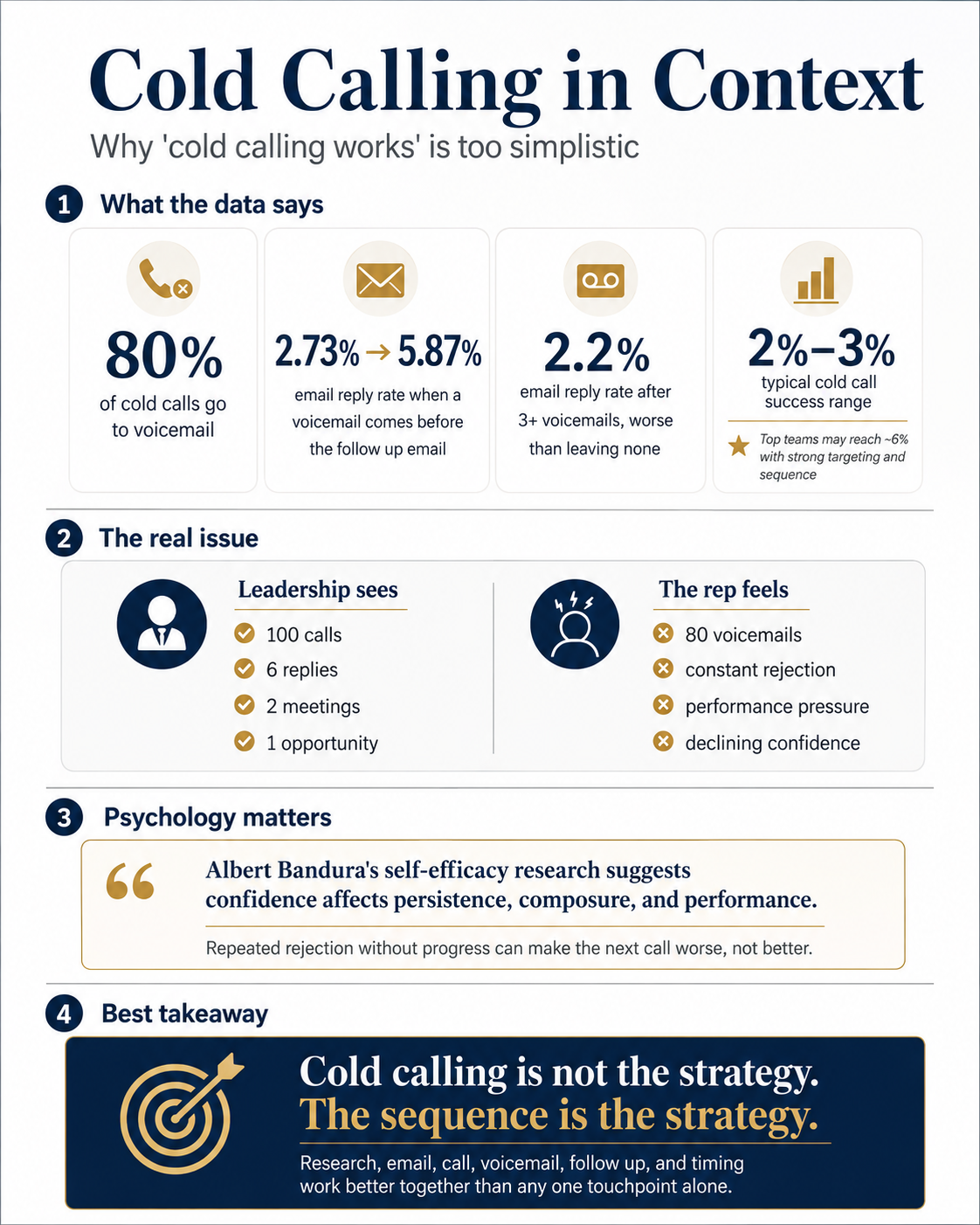
Let’s start with the data everyone loves to throw around. Depending on the source, average cold calling success rates often land somewhere around 2 to 3 percent, with strong, well targeted, well-trained teams sometimes pushing into the 6 to 10 percent range. That sounds useful when you are looking at it from a leadership perspective. If you have a team making thousands of calls, 2 to 6 percent can absolutely create pipeline. But now shrink that down to the individual human being sitting in the chair.
If a salesperson makes 100 calls, and 80 of those go to voicemail, that means the overwhelming majority of their effort is spent not actually speaking to anyone. Of the people who do answer, many are annoyed, distracted, in a meeting, picking up their kids, walking into a dentist appointment, or wondering why their phone did not properly label the call as spam. That is not exactly the warm and fuzzy foundation for a great business conversation.
Then we talk about voicemail. Gong has published data showing that leaving a voicemail before sending a follow-up email can increase email reply rates from roughly 2.7 percent to 5.9 percent. That is a meaningful lift. From a campaign perspective, that is useful. From a leadership dashboard perspective, that is worth paying attention to. But let’s not pretend 5.9 percent is some sales miracle. That still means approximately 94 out of 100 people do not respond.
So yes, a voicemail may improve the effectiveness of the email that follows it. That does not mean voicemail, by itself, works (In fact, Gong's same article shows data showing a voicemail alone reduces your future connect rate by 28%). It means voicemail may act as a supporting touchpoint in a larger sequence. That is the point. The call is not the strategy. The voicemail is not the strategy. The email is not the strategy. The sequence is the strategy.
The call is not the strategy. The voicemail is not the strategy. The email is not the strategy. The sequence is the strategy.
Aggregate Metrics vs. Human Reality
This is the part that does not get discussed enough. Leadership evaluates outbound in aggregate. Salespeople experience it sequentially. A leader sees 100 calls, 20 connects, 6 replies, 2 meetings, and maybe 1 opportunity (on a good day). That can look like progress. The salesperson experiences voicemail, voicemail, not interested, voicemail, wrong person, wrong number, doesn't work anymore, call me next quarter, voicemail, voicemail, voicemail, no answer, immediate hang up, voicemail. That is not just activity.
That is a psychological environment.
If you are already a successful salesperson with a strong book of business, a referral base, existing customers, confidence, credibility, and years of proof that you can sell, those numbers feel different. You know the process works because you have seen it work. You have evidence. You have perspective. You have money coming in. Leadership is usually not hovering over your shoulder asking why your activity is low.

Now compare that to a new rep or a struggling rep. They need a win. They need pipeline. They need confidence. They need to prove they belong. They also probably have leadership watching their activity numbers like a hawk. So now they are sitting in a three-hour call block, getting rejected or ignored most of the time, while also knowing their job depends on creating opportunities. By the time someone finally answers the phone, they are not thinking, “Great, here is my opportunity.” They are thinking, “Please do not reject me, too.”
That changes everything. Their voice tightens. They rush. They pitch too early. They stop listening. They sound scripted. They try to manipulate the conversation instead of leading it. They are not curious. They are not relaxed. They are not present. And ironically, the pressure designed to create performance just reduced the quality of the one conversation leadership wanted them to have. That is the part the spreadsheet does not show.
Self-Efficacy Matters
Psychologist Albert Bandura introduced the concept of self-efficacy, which is essentially a person’s belief in their ability to succeed in a specific situation. This matters in sales because confidence is not just some fluffy motivational poster concept. Confidence changes behavior. People with higher self-efficacy tend to persist longer, recover faster from setbacks, and approach difficult situations with more control. People with lower self-efficacy are more likely to avoid difficult tasks, interpret setbacks as personal failure, and struggle to stay composed under pressure.
Sales is full of rejection. That is not new. But rejection hits differently depending on whether the salesperson believes they are capable of success. A senior salesperson who has closed deals, built relationships, earned referrals, and navigated objections for years hears “no” and thinks, “That is part of the game.” A newer salesperson hears “no” and may think, “Maybe I am not good at this.” Same rejection. Different interpretation. Different outcome.
That is why “just make more calls” is often lazy coaching. More exposure does not automatically create competence. Repetition only helps when the person is learning, adjusting, receiving useful coaching, and gaining enough small wins to build belief. Failure alone does not make people better. Failure plus reflection, coaching, adjustment, and progress makes people better. Failure plus pressure, fear, and repeated rejection makes people worse.
Failure plus reflection, coaching, adjustment, and progress makes people better. Failure plus pressure, fear, and repeated rejection makes people worse.
Stop Comparing New Reps to Senior Reps
One of the worst things sales leaders do is compare struggling reps to top performers without acknowledging the differences in their actual day-to-day reality.
“Look what Sarah is doing.”
“Do what Mike does.”
“John makes calls and he is crushing it.”
Okay, but what kind of calls are those? Are they truly cold? Are they calling existing clients? Are they working referrals? Are they expanding accounts? Are they calling prospects who already know the company? Are they following up from a prior conversation? Are they benefiting from ten years of industry credibility?
A senior salesperson and a junior salesperson may both be “making calls,” but they are often not doing the same job. A junior rep is trying to create momentum. A senior rep is often leveraging momentum. Those are wildly different things.
The senior rep has planted seeds for years. They have relationships. They have pattern recognition. They know what to say because they have heard the same objection 500 times. They are calm because they have evidence that they can win. The junior rep is still trying to build that evidence. So when leadership says, “Just copy what our top rep does,” they may be asking a rookie to copy the finished product without understanding the years of context that created it. That is not coaching. That is comparison dressed up as leadership.
And comparison can be the thief of progress just as much as it is the thief of happiness.
Activity Is Not the Same as Progress
I understand why leaders measure calls. Calls are easy to count. Meaningful conversations are harder to evaluate. Call volume gives leadership something concrete to look at. It creates the illusion of control. But activity without quality is just noise with a CRM timestamp.
The better questions are: How many meaningful conversations happened? How many decision makers engaged? How many prospects entered a thoughtful sequence? Which touchpoint created the response? What messaging worked? What objections are we hearing? Where are reps getting stuck? What can we improve tomorrow?
Those questions lead to better sales teams. “How many calls did you make?” often leads to people doing exactly what they are measured on. They dial. They log activity. They leave bad voicemails. They check the box. They survive the day. And then leadership wonders why the pipeline is weak.
You get what you measure. If you measure dials, you get dials. If you measure conversations, learning, progression, and pipeline quality, you get a much better sales organization, but that's harder and requires an experienced leadership team.
Cold Calling Needs a Job Description
I am not saying the phone has no place in sales. It absolutely does. A live conversation can still build trust faster than almost anything else when it happens at the right time, with the right person, in the right context. But cold calling needs a defined role inside the broader campaign. It should not be “pick up the phone and hope someone buys something.”
It should support a sequence.
- Research the account.
- Send a relevant email.
- Make the call.
- Leave a short voicemail if it supports the follow-up.
- Reference the voicemail in the next email.
- Connect on LinkedIn when appropriate.
- Follow-up with something useful.
- Call again with context.
That is very different from brute-force dialing.
The voicemail should not be trying to sell the entire solution. It should create familiarity, support the next touch, and give the prospect a reason to recognize your name when the email lands. The call is one piece of the pattern. Prospects do not always remember one voicemail. They remember repetition with relevance. They remember seeing your name in multiple places. They remember whether your outreach felt useful or desperate. That is the difference between a campaign and a call block.

Pressure Can Make Salespeople Worse
There is a balance between accountability and pressure. Salespeople need accountability. They need structure. They need activity. They need to be uncomfortable sometimes. Growth requires that. But there is a difference between productive discomfort and constant psychological defeat.
If someone is failing, increasing pressure is not always the answer. Sometimes it is the fastest way to make them worse. A struggling salesperson under heavy pressure is carrying more cognitive load into every conversation. They are thinking about quota, their manager, their job security, their lack of pipeline, the last rejection, the next coaching meeting, and whether they are about to blow their one good conversation of the day.
That mental noise shows up in their voice. Customers can hear it. Prospects can feel it. Nobody wants to be sold by someone who sounds like they are trying not to drown. That is why confidence matters. Not fake confidence. Not chest pounding. Not “coffee is for closers” nonsense. Real confidence built through preparation, practice, small wins, coaching, and proof.
That is why confidence matters. Not fake confidence. Not chest pounding. Not “coffee is for closers” nonsense.
Sales leadership should be asking, “How do we help this person build competence and confidence?” Not just, “How do we get them to make more calls?”
Cold Calling Works Only If You Define "Works" Very Carefully
So does cold calling work? By itself, no. Not in the way many people imply. As part of a thoughtful sequence, with good data, strong messaging, proper timing, good coaching, and realistic expectations, it can contribute to pipeline.
That is the honest answer. But the phrase “cold calling works” is too simplistic. It lets leaders skip the harder questions. What kind of calling? To whom? At what stage? With what follow up? By what kind of salesperson? With what level of preparation? With what psychological cost? With what actual revenue outcome?
Because six replies from 100 prospects may look great on a campaign report, but for the human being living through the other 94, it can feel like failure. That does not mean we should avoid hard things. Sales is hard. It does mean we need to stop pretending raw activity is the same as progress.
The goal is not to create anxious dialers. The goal is to create confident salespeople who can build trust, diagnose problems, and move the right opportunities forward. Cold calling can support that. But it cannot replace strategy. And it definitely cannot replace leadership.