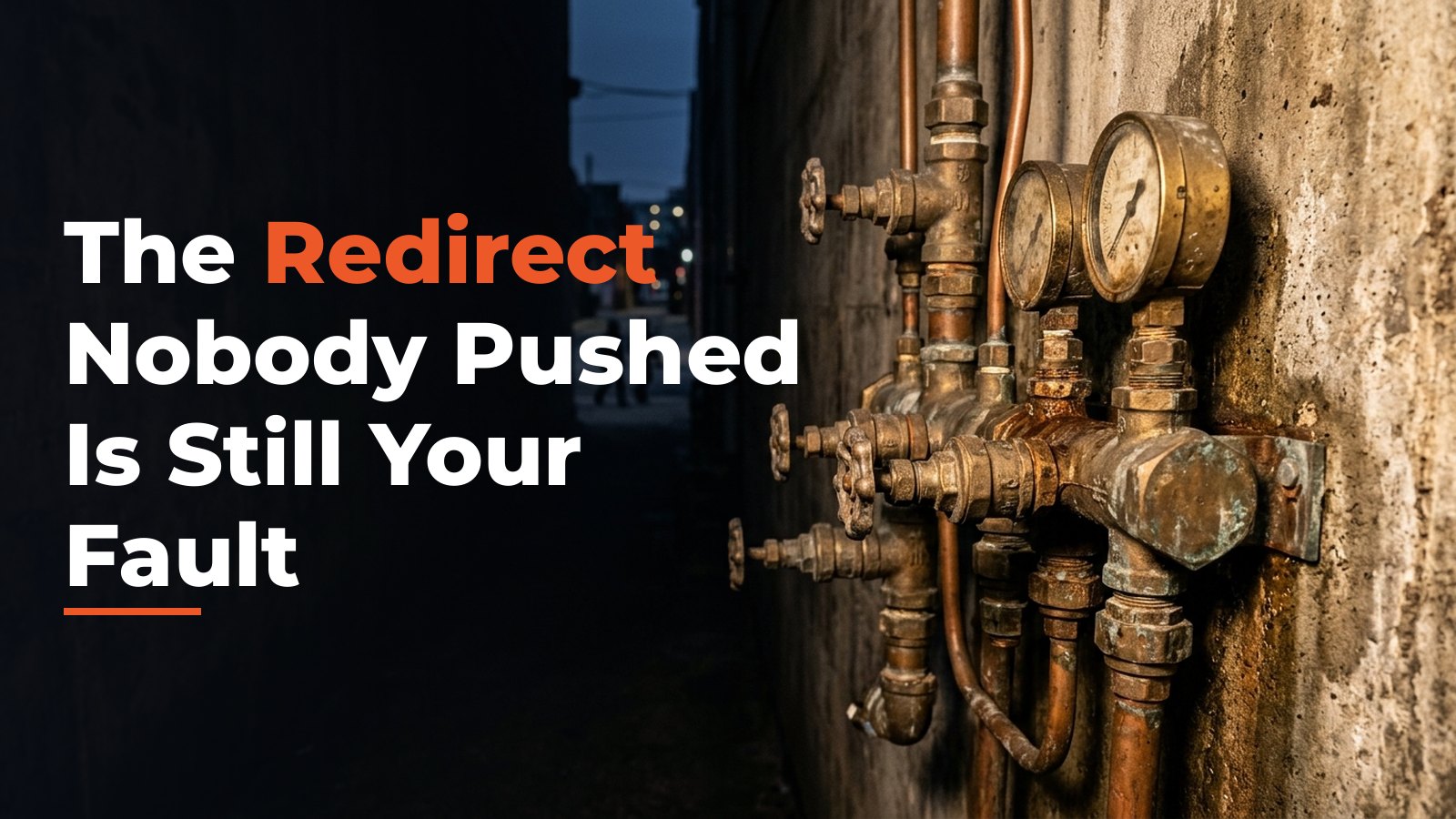
The Redirect Nobody Pushed Is Still Your Fault
Everyone in marketing loves to repeat that your website is the one channel you actually own. Rent attention on a social platform and the rules can change overnight. Buy clicks and the price floats. But your own site? That is yours. Forever. No landlord.
It is a comforting story. It is also mostly wrong.
This week there was a quiet little item moving through the SEO news, the kind Matt Southern covers in Search Engine Journal's roundups. WordPress sites were throwing redirects nobody had set up. Random ones. A page you published, live and fine yesterday, suddenly bouncing visitors somewhere you never told it to. No marketer wrote that rule. No developer approved it. It just started happening.
Most people read that, shrugged, and scrolled on to the algorithm gossip. I want to stop on it, because it says something uncomfortable about how we actually run our websites.
The redirect nobody ordered
Think about what a redirect is. It is an instruction. It tells a browser, and a search crawler, do not look here, go there instead. It is one of the most powerful things you can do to a URL, because it reassigns authority, breaks or preserves rankings, and quietly decides whether a visitor ever reaches the thing you spent money to make.
Now imagine one of those firing on your site without anyone choosing it.
That is not a cosmetic glitch. That is your plumbing making a decision on your behalf and not telling you. And the first time most teams notice is not when the redirect appears. It is weeks later, when a page that used to convert goes quiet, and someone finally asks why.
A redirect you never set up is still a decision your website made, and you still own the consequences.
Here is the part that stings. When that traffic dip shows up, where do we look first? Google. We check for an update. We blame the algorithm, the AI Overviews, the spam filter, the mysterious hand of the search gods. We go hunting for the enemy outside the walls. Meanwhile the problem is sitting inside our own stack, wearing our own branding, shipped by software we installed and forgot about.
You do not run a website. You run a supply chain.
Let me kill the myth properly. You do not own your website the way you own a house. You own it the way a restaurant owns its dinner service. The space might be yours. The recipe might be yours. But the ingredients, the delivery trucks, the gas line, the point of sale terminal, the booking software, all of that comes from someone else, and any one of them can change its behavior without asking you first.
A typical site today is a stack of other people's decisions. A content platform like WordPress. A theme built by a third party. A dozen plugins, each maintained by a separate team on a separate schedule. A content delivery network sitting in front of all of it. Analytics bolted on top. A tag manager firing scripts you have never read. Maybe a form tool, a chat widget, a consent banner, a payment layer.
Every one of those is a vendor. Every one of those updates itself. And every one of those can, in theory, do what WordPress just did: change what your site does before you knew it could.
You did not build a website. You assembled one from parts you do not inspect and cannot fully see.
That is not a reason to panic. Every modern business runs on borrowed infrastructure, and that is usually a good trade. The problem is not that we rent. The problem is that we rent and then pretend we own, which means we never bother to check whether the plumbing still works the way it did last month.
The silent changelog
We spend a lot of energy chasing Google's updates. People refresh the changelog like it is a scoreboard. But Google at least announces most of its big swings. It gives them names. It writes blog posts.
Your plugins do not.
A plugin can push an update at two in the morning that changes how it handles canonical tags, how it rewrites URLs, how it loads scripts, or whether it respects the rules you set six months ago. There is a changelog somewhere, sure. A paragraph of release notes nobody on your marketing team will ever read. The update installs, the behavior shifts, and the first signal you get is a number moving in the wrong direction.
This is the quieter cousin of every algorithm scare. We have trained ourselves to watch the one actor who publishes press releases and ignore the dozen actors who change things in the dark. The threat is not that Google moved. The threat is that your own tools moved and nobody was watching the door.
Which raises an honest question. When did you last audit what is actually installed on your site? Not what you think is installed. What is actually running, firing, and making decisions right now?
Branded data, and the gift with a leash on it
In that same roundup there was a smaller note that Search Console's API is making branded search data easier to work with. Good news on its face. If you want to understand how people search for your own name, having that data flow cleanly into your reports is genuinely useful. Branded search is where your reputation shows up as demand.
But notice the shape of it. The data about your own brand, searches for your own company name, arrives through Google's pipe, on Google's schedule, in the format Google decides to give you. It is your data about you, filtered through someone else's system.
That is the same pattern as the redirect, just friendlier. A layer you do not control is deciding what you get to see about yourself.
I am not waving a conspiracy flag here. Google is not hiding your brand from you. The point is structural. Almost everything you know about your own performance reaches you secondhand, through tools and APIs and dashboards that sample, delay, model, and sometimes just change their definitions without a headline. When the pipe changes, your understanding changes, and you did not touch a thing.
Most marketers do not measure their own business. They measure what their vendors are willing to report about it.
So when the branded data suddenly looks different next quarter, the discipline is the same as with the redirect. Ask whether the business changed or whether the instrument changed. Those are very different problems, and treating a measurement shift like a demand shift is how teams end up fixing things that were never broken.
The CDN is a decision, not a setting
The roundup also touched on guidance around content delivery networks, the layer that caches your site and serves it fast from somewhere near your visitor. CDNs are close to magic. They make a slow site quick and a fragile site resilient.
They are also another gatekeeper standing between your content and the people and machines trying to read it.
A CDN decides what gets cached and for how long. It can decide which requests look suspicious. It can decide, through a security setting someone enabled and forgot, that a crawler is a threat. I have watched a site quietly stop getting indexed because a protective rule at the edge was politely turning Google away at the door, and everyone upstream assumed the content was the problem.
Nobody did anything obviously wrong. Someone picked a sensible default. The default did its job a little too well. And a decision that felt like a checkbox turned into a decision about who gets to see your business.
A CDN is not a setting you flip once and forget. It is a bouncer you hired. And a bouncer makes judgment calls every night whether or not you are there to supervise.
Who is actually holding the keys
Which brings me to the last thread in that roundup, the question of who controls access for bots and the new wave of AI agents. This is usually framed as a policy debate, big platforms arguing about rights and crawling. Fine. But down at your level it is much more practical and much more personal.
Every layer I have described is also a layer that can grant or deny access. Your CMS. Your CDN. Your robots rules. Your security plugin. Your host. Each of them can decide, independently, whether a crawler, an assistant, or a buyer gets through. You did not make one access decision. You made a dozen, scattered across a dozen vendors, most of them on defaults you never chose on purpose.
So when someone asks whether AI tools can read your site, or whether Google is indexing you properly, the honest answer is often: I am not sure, because I delegated that decision to five different systems and never checked what they agreed on.
You cannot have a clear access strategy when five different vendors each hold a key and none of them talk to each other.
Boring plumbing is a strategy
Here is the thing that connects a random redirect, a branded API, a CDN rule, and a bot policy. None of them are glamorous. None of them will be the subject of a keynote. You cannot build a thought leadership post around checking your plugin updates.
And that is exactly why nobody does it.
We treat marketing strategy as the interesting layer, the campaigns and the messaging and the positioning, and we treat the technical stack as a utility that either works or does not, like electricity. But electricity is not neutral when the wiring is old. Your stack is not neutral. It is a pile of small, automated, self updating decisions, and every one of them can override your strategy without a meeting.
I am not telling you to become a systems administrator. I am telling you to stop assuming the floor is solid just because you were standing on it yesterday. The teams that get burned by this are not the ones with bad strategy. They are the ones with good strategy sitting on infrastructure nobody has looked under in a year.
So build the unglamorous habits. Know what is installed. Read the release notes that matter. Keep a record of what your redirects, your CDN, and your access rules are supposed to do, so you can tell when something has quietly changed its mind. Watch your own instruments for drift, not just your rankings. Treat every vendor in your stack as what it actually is, a party that can act on your behalf whether or not you asked.
Because the scariest change to your website this year will not come with a name, a press release, or a date. It will come from inside your own stack, at some hour you were not watching, from a tool you trusted enough to stop thinking about.
And when it does, the search engine will not be the one who redirected your customers. You will.