True Facts, False Answer: Why AI Keeps Mistaking Your Business For Someone Else
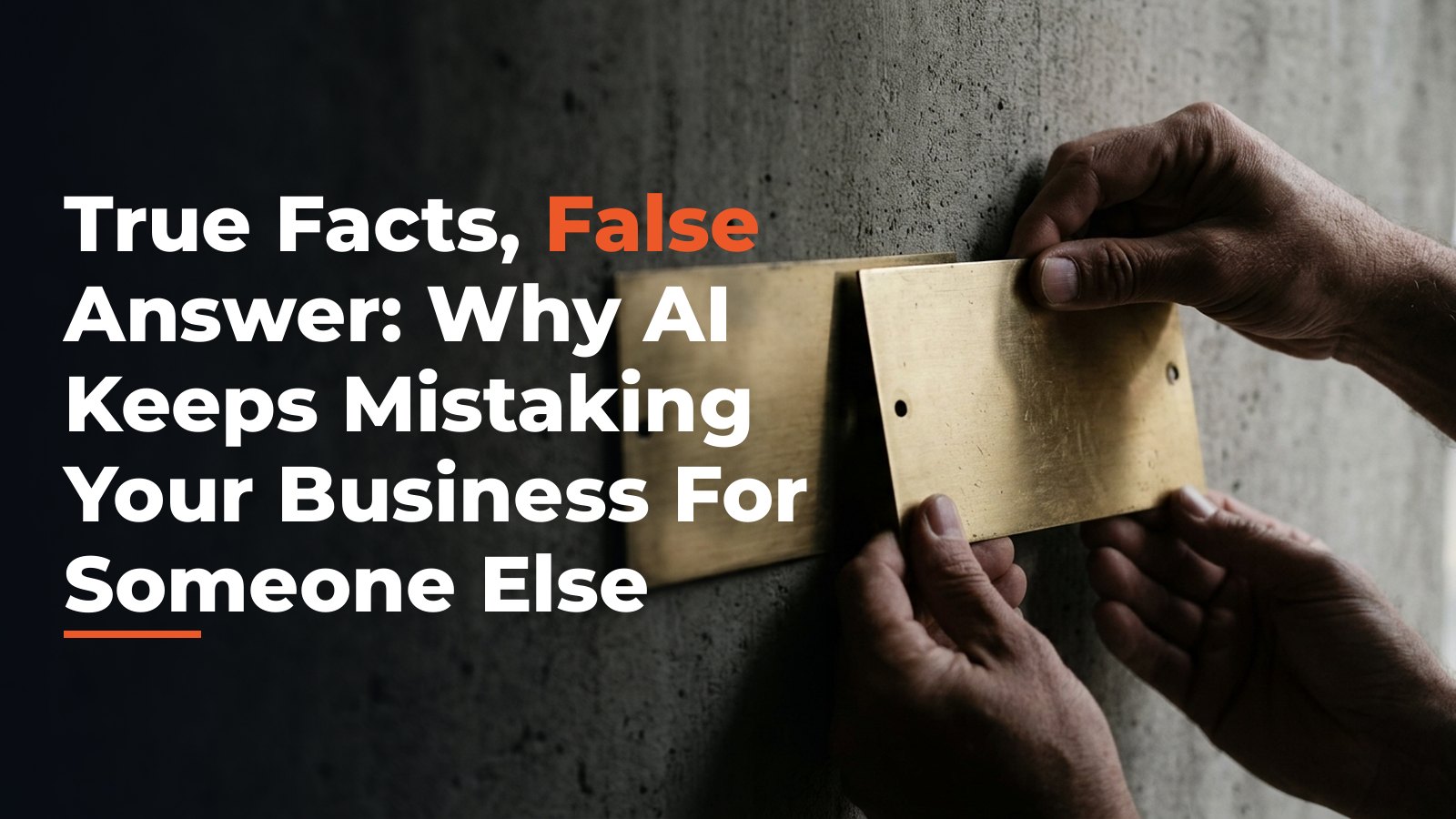
Here is a belief I hear in almost every room now. As long as the facts an AI pulls are accurate, the answer it gives will be accurate too. Clean inputs, clean outputs. Garbage in, garbage out, and the reverse.
It sounds obviously true. It is also wrong, and in a way that should make every business owner sit up.
Because an AI system can pull nothing but accurate, verifiable, true facts and still hand a customer a completely false answer about your business. Not because it lied. Because it stitched real facts about two different companies into one, and presented the seam as if it were skin. The scary part is not the hallucination everyone warns you about. The scary part is the confident, well sourced, factually supported answer that happens to be about the wrong company.
Accuracy and truth are not the same thing
We have spent two years training ourselves to fear AI hallucinations. The made up citation. The invented quote. The court filing with fake cases in it. And fair enough, those are real and embarrassing.
But hallucination is the loud failure. It is the drunk uncle at the dinner table. You can see it coming and you know to discount it.
Conflation is the quiet one. Conflation is when the system takes true fact A about your company and true fact B about a company with a similar name, a similar category, or a similar location, and merges them into a single entity that does not exist. Every sentence is defensible. Every sentence is sourced. The whole is a lie.
Hallucination invents facts. Conflation gets the facts right and gets the company wrong.
A pile of accurate bricks is not automatically a house. You can stack real bricks into a wall that falls on someone. The individual truth of each brick tells you nothing about whether the structure is sound.
So when someone tells me their AEO strategy is just making sure the facts about them online are correct, I ask the obvious question. Correct according to whom, and attached to which entity? Because the machine does not know your business is yours. It knows there is a cluster of text that mostly points at something. Mostly is doing a lot of work in that sentence.
How two businesses become one in the model's eyes
Large language models and the retrieval systems feeding them do not store a tidy file called Your Company. They operate on patterns, associations, and probability. When a user asks about you, the system gathers whatever sits near your name in its training and its live sources, and it blends.
Blending is the whole trick. It is also the whole problem.
Say there are two firms. Yours, and another one three states over with a name one word off from yours. Same industry. Maybe a founder with the same first name. The model has seen both. When someone asks about you, it reaches for the strongest, most repeated associations near those tokens, and some of them belong to the other firm. It does not feel uncertainty the way you would. It produces one smooth answer. Your services, their lawsuit. Your pricing, their bad reviews. Your reputation, their refund policy.
Now ask yourself a harder question. How would you even know this is happening?
You would not, mostly. Unless you went looking, or a customer mentioned something strange they read, or a deal went cold for a reason nobody could name. The answer is not on a dashboard. It is in a private chat between a prospect and a machine, and you never see the transcript.
The courts are starting to notice
For a long time the platforms have hidden behind a comfortable idea. We are just an index. We are a neutral pipe. We point at what is out there, we do not author it, so we are not responsible for what it says.
That argument made sense for a list of blue links. You click, you leave, you land on someone else's page, and that page owns its own words.
An AI answer does not work like that. The machine is not pointing at a source. It is writing a new sentence, in its own voice, as a direct answer, and often the user never clicks anything at all. The platform stopped being a librarian pointing at a shelf. It became the author of the summary.
The moment a platform writes the answer instead of pointing at it, the old excuse about being a neutral pipe stops working.
And courts are beginning to treat it that way. When a synthesized answer defames a real business or a real person by fusing them with someone else's facts, the question of who is responsible gets a lot more interesting. You cannot both claim the authority to write the definitive answer and disclaim all responsibility for what the answer says. Pick one.
I am not a lawyer and I will not pretend to predict exactly where this nets out. But the direction of travel is clear enough. The more these systems speak in their own confident voice, the harder it gets to call that voice nobody's problem.
Why this is your problem too, not just the platform's
Here is the part marketers do not want to hear. The fact that a court might eventually hold a platform liable does you almost no good in the moment a prospect reads the wrong thing about you and quietly moves on.
You do not get to sue your way to a good reputation. Liability is a backstop, not a strategy.
So while the legal system slowly sorts out who owns the output, your job is to make your business so clearly itself that the machine has no room to blend you with anyone. You cannot control the model. You can control how distinct your entity is in the material the model learns from.
Think of it like this. If you and the firm three states over are both a blurry gray smudge online, the machine will average the smudges. If you are a sharp, specific, internally consistent shape, there is nothing to average you against. Clarity is the defense.
Making your entity unmistakable
This is where entity SEO and AEO stop being buzzwords and start being plumbing. The goal is not to stuff keywords. The goal is to give every system a consistent, unambiguous picture of who you are, so there is no gap for a lookalike to slip into.
A few things that genuinely move the needle here:
- Be ruthlessly consistent with your name, address, and core descriptors everywhere. Same legal name, same formatting, same category language across your site, your profiles, your listings, and anywhere you get cited. Every inconsistency is a crack the model can misread.
- Use structured data to spell out what you are and what you are not. Organization markup, clear entity identifiers, links to your own authoritative profiles. You are handing the machine a labeled file instead of making it guess.
- Claim and tighten the sources these systems trust. The knowledge panels, the reputable directories, the industry references. If the authoritative sources about you are clear, the derived answer has a cleaner foundation to stand on.
- Own your differentiators in plain language. If your name is close to someone else's, say what sets you apart in text, on the record, often. Give the model the exact phrases it needs to keep you separate.
None of this is glamorous. It is closer to filing and labeling than to creative work. But it is the difference between being a distinct entity and being one of two smudges the machine shrugs and averages.
That matters.
Stop auditing facts. Start auditing identity.
Most brand audits I see check whether the facts online are correct. Is the phone number right. Is the address current. Are the service descriptions accurate. Good hygiene, all of it, and necessary.
But it answers the wrong question. It asks, are my facts true? The question that actually protects you is, could my true facts be attached to the wrong company, or could someone else's facts get attached to mine?
Go ask the machines directly. Open the AI tools your customers actually use and ask about your business the way a stranger would. Ask what you do. Ask who founded you. Ask about your reputation, your pricing, your track record. Then read the answer like a suspicious editor, not a proud owner.
Look for the seams. A detail that is almost right. A claim you never made. A tone that does not sound like you. An achievement or a complaint that belongs to someone with a name close to yours. Those seams are where conflation lives, and once you see one, you usually see more.
The question that protects you is not are my facts true, but could my true facts get attached to the wrong company.
Do it quarterly. These systems retrain, re rank, and re source constantly, and the lookalike that was invisible last quarter can surface this one.
The uncomfortable takeaway
We built a whole mental model around a simple promise. If the inputs are true, the output is trustworthy. For search engines that mostly held, because the engine mostly just handed you the source and let you judge.
The machines writing answers now broke that promise, quietly, without telling anyone. They can be fed nothing but truth and still produce something false, because truth about the wrong entity is just an elegant kind of error. And they say it with the same calm confidence they use for the correct answers. There is no tremor in the voice to warn you.
Courts will do what courts do, slowly, and the question of platform responsibility is going to get genuinely interesting over the next few years. I will be watching it closely. But I would not wait on a verdict to protect my own name.
Accuracy is not the finish line. It is the starting line. The real work is making your business so unmistakably itself that no machine, and no lookalike, can borrow your identity by accident.
Get your facts right. Of course. Then go make sure they are still pointing at you.