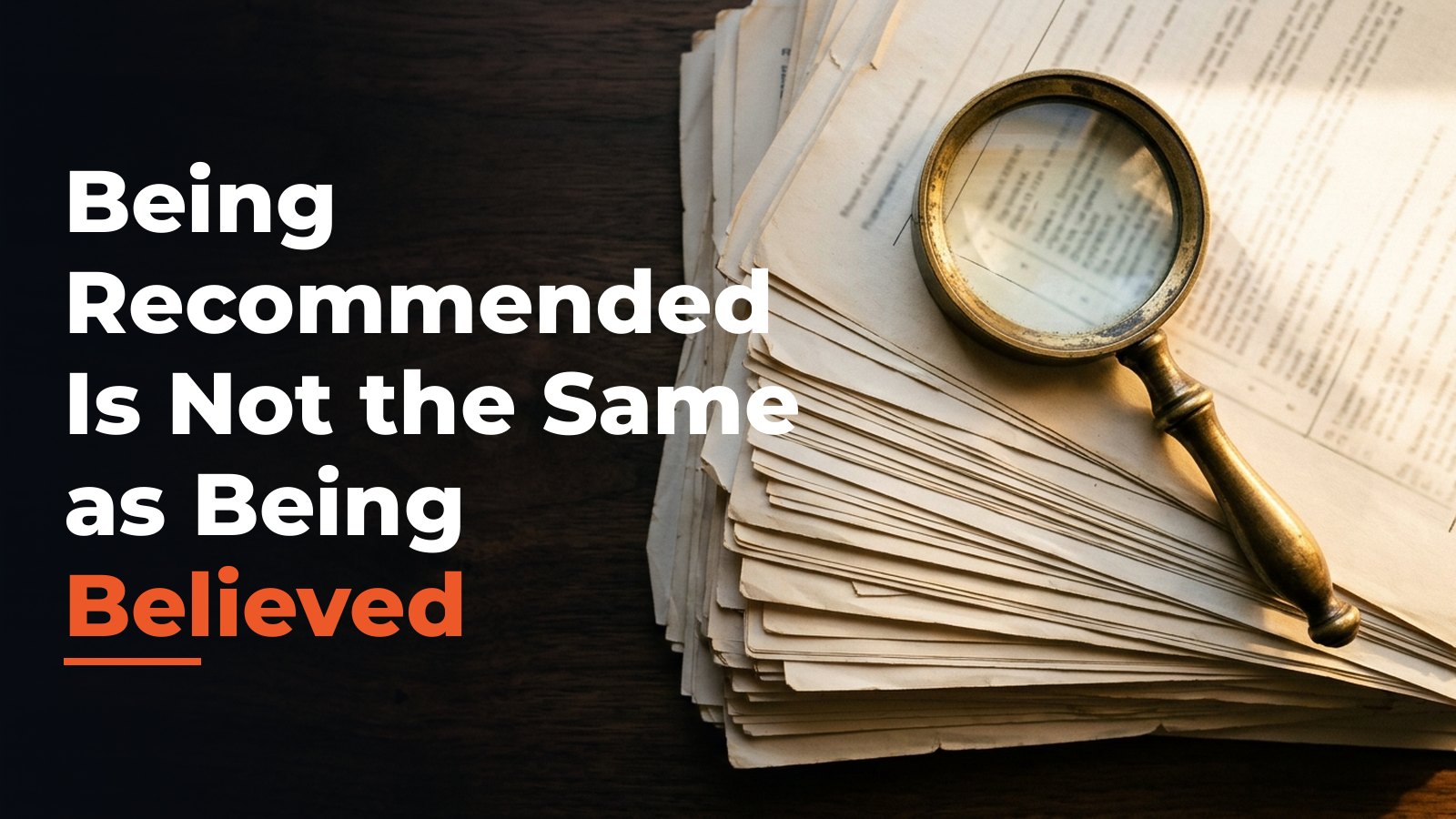
Being Recommended Is Not the Same as Being Believed
Everyone in marketing has the same new north star. Get recommended by the AI. Show up when someone asks ChatGPT or Google's AI answers "what is the best tool for this," land on the short list of names it says back, and let momentum do the rest.
I get the appeal. For twenty years we fought over a blue link on page one, and now there is a cleaner, shorter prize: be one of the three names the machine says out loud. That feels like the whole ballgame.
It is not. It is getting invited to audition.
The prize everyone is chasing is only half a prize
Here is what actually happens after you get mentioned. A buyer reads the recommendation, nods, and then does the thing buyers have always done. They start poking. Does it integrate with the stack we already run? What does the actual workflow look like on a Tuesday, not in the demo? Who else like us has used this, and did it do what it promised?
That is the moment. Not the mention. The follow up.
And increasingly it is not just a human doing the poking. The newer AI tools do not stop at naming three options. They go deeper when pressed. They compare. They summarize what people say about you. They surface the integration you do not have and the complaint you never answered. The recommendation and the scrutiny are starting to live in the same conversation.
Visibility gets you into the room. Evidence is what keeps you from getting walked right back out of it.
So when I hear a founder celebrate that their company "shows up in ChatGPT now," my first question is not how. It is: and then what? Because showing up is the cheap part now. It is getting cheaper by the month. The expensive part is surviving the ten seconds after someone decides to look a little closer.
A recommendation you cannot back up is a liability with good PR
Think about what a recommendation really is. When an AI names you, it is making a small bet on your behalf. It is saying, to a stranger, "this one is worth your time." That is borrowed credibility. It is not yours. You are holding it.
And borrowed credibility comes with a bill.
If the buyer looks and finds that the claims hold up, the loan converts into trust. If they look and find nothing, or worse, find a gap between what you say and what you can show, the whole thing reverses. Now the recommendation has made you look worse, because it raised expectations you could not meet. You did not just fail to close. You taught that person that the AI's picks are not reliable, which means the next name on the list benefits from your flop.
This is the uncomfortable truth hiding under all the AI visibility excitement. Visibility can actively hurt you if the evidence underneath it is thin. A spotlight does not flatter an empty stage.
Your best proof is locked in a PDF nobody can open
Here is where most companies are genuinely stuck, and they do not even know it. Their evidence exists. It is just in all the wrong places.
The killer case study is a slide in the sales deck, shared after the third call. The outcome numbers live in a gated report you trade for an email address. The integration list is a logo wall that is really just a picture, with no words a machine can read. The glowing quote is a screenshot. The one that proves you can actually do the thing is in a recorded webinar forty two minutes deep.
None of that exists, as far as an AI is concerned. None of it exists for the buyer doing a fast, skeptical scan at nine at night either.
We built a whole marketing habit around hoarding proof. Gate it. Save it for the demo. Make them earn it. That logic made a kind of sense when a human sales rep controlled the sequence and could hand over the evidence at the perfect moment. That control is gone. The evaluation now happens before you ever get a name or an email. It happens in a chat window and a browser tab, without you in the room.
If your proof only appears after the sales call, you have hidden it from the exact moment it was supposed to win.
So the case study that could have closed the deal is sitting behind a form, invisible, while the AI shrugs and recommends the competitor who published theirs.
What counts as evidence now
Let me be precise about what I mean by evidence, because it is not the same as content, and it is definitely not the same as claims.
A claim is "we help teams move faster." Everyone says that. It is wallpaper. A machine cannot tell your wallpaper from anyone else's, and neither can a tired buyer.
Evidence is specific, checkable, and attributable. It survives a follow up question.
- Named outcomes. Not "customers save time," but what kind of customer, doing what, with what result, that someone could in principle verify.
- Integrations stated in plain words, not just logos. If you connect to a system, say so in text, on a page, where it can be read and cross referenced.
- The actual workflow. What it is like to use the thing, step by step, before and after. The boring operational truth, not the aspirational one.
- Third party corroboration. Reviews, independent write ups, comparisons where you did not control the framing. The stuff you cannot fake.
Notice that almost none of this is persuasive writing. That is the point. Evidence is not supposed to persuade. It is supposed to withstand. Persuasion is what you do when you do not have proof. Proof does not need an adjective.
The buyer and the bot are asking the same question
There is a convenient overlap here that most people miss. The AI and the human buyer are now hunting for the same thing, and they get stumped by the same gaps.
When a buyer asks "will this work for a team like mine," they are looking for a match: someone like them, a situation like theirs, an outcome they want. When an AI tries to justify recommending you over the other two names, it is reaching for the same thing. Specifics it can point to. Corroboration it can lean on. A reason that is not just your own say so.
So the work of becoming legible to machines and the work of becoming convincing to humans have quietly merged. You do not need two strategies. You need to stop hiding your evidence and start publishing it where both can find it.
That matters more than any prompt trick or schema hack, because it is durable. Tactics for getting mentioned will change every few months as these systems evolve. The underlying demand for proof will not. Buyers wanted evidence before the internet, and they will want it after whatever comes next.
Visibility is a loan. Evidence is a deposit.
I keep coming back to this frame because it clarifies where to spend. Visibility is a loan. It shows up fast, it feels great, and it has to be paid back the moment anyone looks closely. You can borrow a lot of it quickly right now, which is exactly why it is worth so little on its own.
Evidence is a deposit. It is slow. It compounds. Every real outcome you publish, every honest workflow you document, every integration you state plainly, sits there doing quiet work forever, available to the buyer and the bot at the exact moment of doubt.
Most marketing budgets are currently pouring money into the loan and starving the deposit. They are optimizing to get named, and doing almost nothing to make sure the name holds up under the follow up. It is the equivalent of spending everything on the storefront and leaving the shelves empty. People walk in because the window looked great. Then they look around and leave, and now they distrust the window too.
Stop asking how to get recommended. Ask what happens next.
If you take one thing from this, make it a change in the question you ask yourself.
The industry question right now is "how do we get the AI to recommend us." Fine. Useful. But it is the wrong first question, because it optimizes the easy half and ignores the half where deals actually die.
The better question is: when someone acts on that recommendation and starts to dig, what do they find? Is the proof there, in public, in words, ready for the moment of scrutiny? Or does the trail go cold right when it matters, leaving the buyer and the bot to quietly move to the next name?
Getting on the list was always going to get easier. That is what these tools do. They lower the cost of being mentioned, which means a mention is worth less, not more. The scarce thing, the thing that will decide who wins, is not attention. It is whether you can back up the attention you get.
Anyone can be recommended now. Being believed is the part they cannot fake for you.