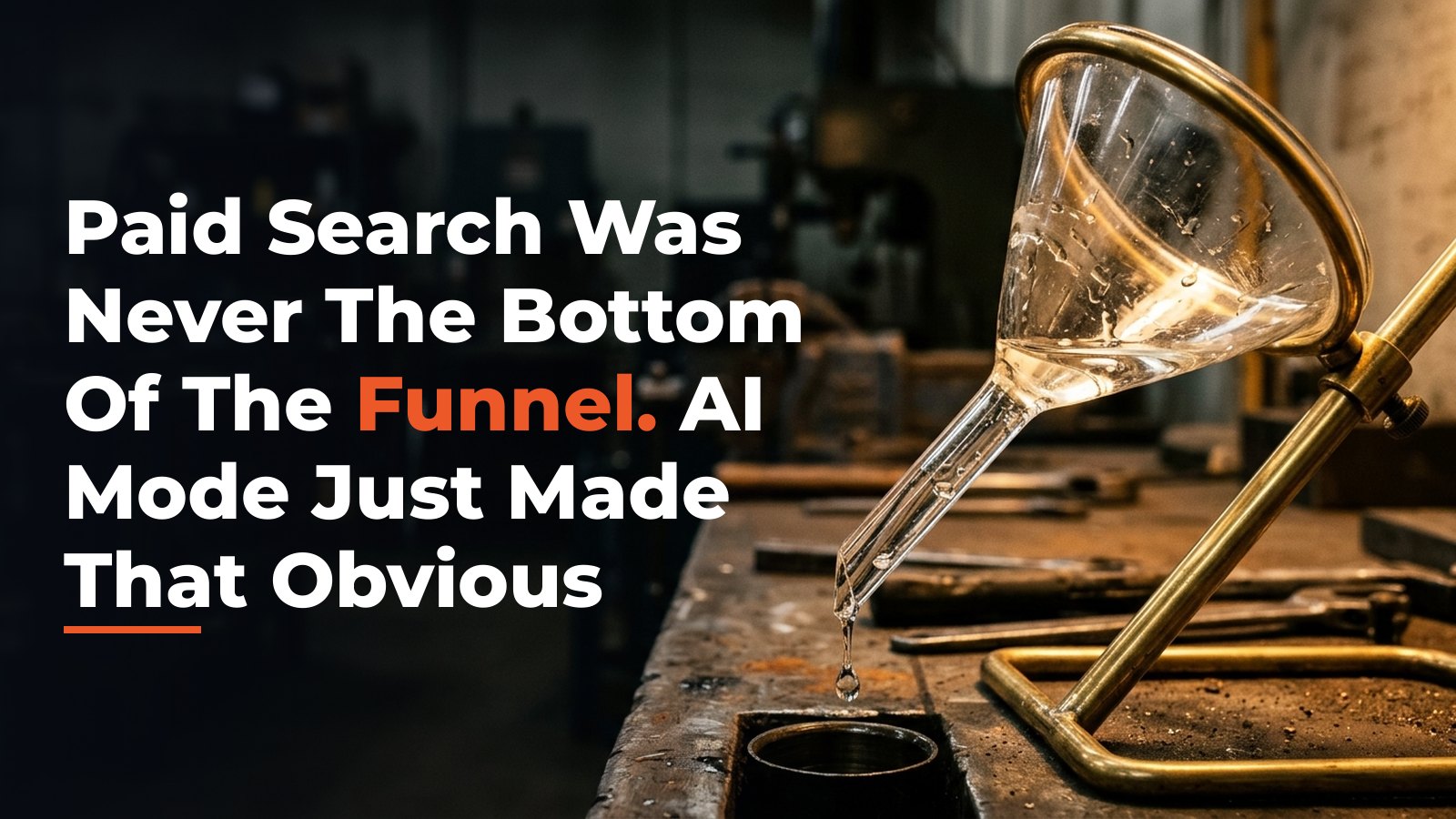
Paid Search Was Never The Bottom Of The Funnel. AI Mode Just Made That Obvious
For as long as I have been doing this, paid search has been treated as the safest bet in the entire media plan. Somebody types your product into Google, you pay for the click, they buy. Intent in, revenue out. The nearest thing marketing has to a vending machine.
So when Google quietly acknowledged that clicks from its new AI Mode convert less and pay less, a lot of people treated it as a footnote. It is not a footnote. It is a crack in the thing everyone assumed was load bearing.
I want to pressure test the belief that paid search is, and always will be, the bottom of your funnel. Because I think that stopped being true a while ago, and AI Mode is just forcing us to admit it.
The comfortable story we have been telling ourselves
Here is the story. Search ads work because they meet demand that already exists. The person searching "emergency plumber near me" is not browsing. They have a burst pipe and a wet carpet. You are not creating desire, you are catching it at the exact moment it peaks.
That story is clean, and for a long stretch it was mostly right. It is why search budgets survived every recession, every CMO reshuffle, every "we need to cut spend" meeting. You could draw a straight line from the keyword to the sale. Finance loves a straight line.
But that story only holds if the search itself still represents a tight, late stage intent. And that is precisely the thing AI Mode is pulling apart.
Paid search was never magic. It was a proxy for intent, and the proxy is drifting.
When Google starts answering the question inside the results page, the click you pay for is no longer the moment of decision. It is something earlier, fuzzier, and less likely to end in a purchase. Google is not hiding this. They are telling you the clicks pay less. Believe them.
What AI Mode actually changes
Think about how a search used to work. You had a question, you typed a few words, you scanned a list of ten blue links and some ads, and you picked. The friction of that process did some quiet filtering for you. The people who clicked through were often the people ready to act.
Now the model answers first. It summarizes, compares, recommends, and sends you deeper into a conversation. Somebody researching a water heater can get the whole landscape of options, trade offs, and rough pricing without clicking a single ad. By the time they do click, they have already done the comparing. Or they do not click at all, because they got what they needed.
So who is left clicking the ads?
Two groups, mostly. People so far down the path that they would have found you anyway, and people so early that they are just poking around. The fat, profitable middle, the researcher who was genuinely persuadable by your landing page, is getting intercepted upstream by the AI.
That is what "moving up the funnel" really means. Not that search stopped working. That the mix of who shows up has shifted toward the curious and away from the committed.
Okay, compared to what?
Whenever someone tells me a channel is underperforming, I ask the same annoying question. Compared to what?
Because a paid search click that converts at a lower rate is not automatically a bad click. If it costs less and still produces revenue at an acceptable return, who cares what the conversion rate used to be? Rate is a vanity number. Profit is the real one.
The danger is not that AI Mode clicks convert worse. The danger is that your account is still optimized as if every click is a hand raiser ready to buy. You are bidding bottom funnel prices for top funnel traffic. You are sending a curious browser to a "buy now" page built for someone who already decided. You are measuring a slow discovery journey with a last click model that gives all the credit to whatever happened five minutes before checkout.
In other words, the traffic changed and your account did not. That gap is where budgets quietly bleed out.
You are not being punished by AI Mode. You are being punished by an account built for a buyer who no longer shows up the way you assumed.
The four things I would actually test
I am allergic to advice that is just a vibe, so let me be concrete. If I believed my paid search traffic was drifting earlier in the journey, here is what I would test in a real account before I touched the budget total.
- Separate the intent tiers. Stop lumping "best tankless water heater" and "install tankless water heater today" into the same campaign with the same bid and the same landing page. The first is research. The second is a job about to happen. Treating them identically has always been sloppy. Now it is expensive.
- Build landing pages for the stage, not the sale. If more clicks are arriving curious, a page that only screams "request a quote" will bounce them. A page that answers the question they were actually asking, then invites the next small step, will keep more of them. Match the page to the headspace.
- Fix your measurement window before you judge the channel. If discovery is moving earlier, your conversions are moving later. A last click, same session model will make early stage search look worthless, because the payoff shows up days later under a different source. If you cannot see assisted and delayed conversions, you are flying blind and calling it data.
- Protect, do not panic cut. The instinct when a channel looks softer is to slash it. But if you cut the early stage terms, you may be cutting the first touch that feeds every other channel. Trim the genuinely wasteful. Do not amputate discovery because your attribution cannot see it.
Notice that none of these are about spending more. They are about aligning the account with reality. Most "paid search is dying" takes are really just "my account is out of date" in a scarier costume.
Why this is really a measurement problem
Here is the part that keeps me up more than the AI itself. The biggest risk is not that AI Mode steals conversions. It is that your analytics will misdiagnose what happened, and you will make the wrong cut with total confidence.
GA4 and most ad platforms still love the moment closest to the sale. If a buyer discovers you through a paid search click, goes away, thinks about it, comes back through a direct visit or a branded search a week later, and buys, the story your dashboard tells is that paid search did nothing and direct traffic is a hero. That was always a little bit of a lie. As search moves up the funnel, it becomes a big lie.
So you look at your report, you see paid search conversions sliding, and you conclude the channel is failing. You cut it. And then, three weeks later, your so called high performing direct and organic numbers start sagging too, because you starved the thing that was feeding them. You cannot see the root, so you blame the leaves.
A hammer is not a house. A last click conversion is not a customer journey. The tool is measuring a single swing and you are trying to understand the whole build.
If your attribution can only see the final click, AI Mode will quietly make your best early channels look like your worst.
The opportunity hiding inside the bad news
Let me turn this over, because there is a real upside here and almost nobody is talking about it.
If paid search is moving up the funnel, then paid search is becoming a discovery and influence channel, not only a closing channel. That is not purely a loss. That is a chance to be present in the research phase, in the moment people are forming opinions, before your competitor is even in the consideration set.
The brands that win the next couple of years will not be the ones who fight AI Mode. They will be the ones who accept that the first meaningful interaction now happens earlier, and who show up there with something genuinely useful instead of a desperate "buy now" banner.
That means content that answers real questions, so you get surfaced when the model summarizes. That means ads that respect where the person actually is in their thinking. That means a measurement setup honest enough to give credit to the early touch. None of this is exotic. It is just unglamorous, and unglamorous work is exactly what gets skipped when everyone is chasing the shiny panic headline.
What I would stop believing right now
So let me say the quiet part plainly. Stop believing that a paid search click is automatically a buyer. It was never fully true, and AI Mode has made the gap too wide to ignore.
A click is a signal of attention, not a signal of readiness. Some of that attention is red hot and ready to transact. Some of it is lukewarm curiosity that needs another few days and another few touches. Lumping them together, pricing them the same, pointing them at the same page, and judging them on the same last click report, that is the mistake. AI Mode did not create the mistake. It just turned up the volume until you could finally hear it.
The channel is not dying. The easy version of it is. The version where you could be lazy about intent, lazy about landing pages, and lazy about attribution, and still get paid because the search box did your filtering for you. That version is ending. Good riddance, honestly.
Google told you the clicks pay less. The useful read is not "search is over." The useful read is this. Your account is still waiting at the bottom of a staircase, and your customers already walked up to a different floor.
Go find them there.