Stop Chasing Google's Update Changelog
If you work anywhere near marketing, you have heard the advice a hundred times. Stay on top of every Google update. Read the release notes, watch the SEO news, adjust your playbook the moment something ships.
I want to challenge that. Not because updates do not matter, but because treating the changelog as your strategy is one of the fastest ways I know to stay busy and go nowhere.
This week is a perfect example. Google refreshed its spam guidance with new advice about indexing pages that are built to be shared. There were updates about restaurant ordering controls, changes to how report dates work, and news about revenue inside AI Mode. If you read the headlines, you felt a small jolt of pressure. Another list of things to react to.
So let me ask the question nobody in the SEO news cycle wants to ask out loud.
Compared to what?
The changelog is not a strategy
Here is what I have watched happen with real clients for years. A company decides it is going to be serious about search. So it starts following the updates. Every tweak, every documentation change, every rumor of a core update. The team builds a kind of nervous system around Google's announcements. Something ships, they panic, they patch, they move on to the next thing that ships.
They feel productive. They are not.
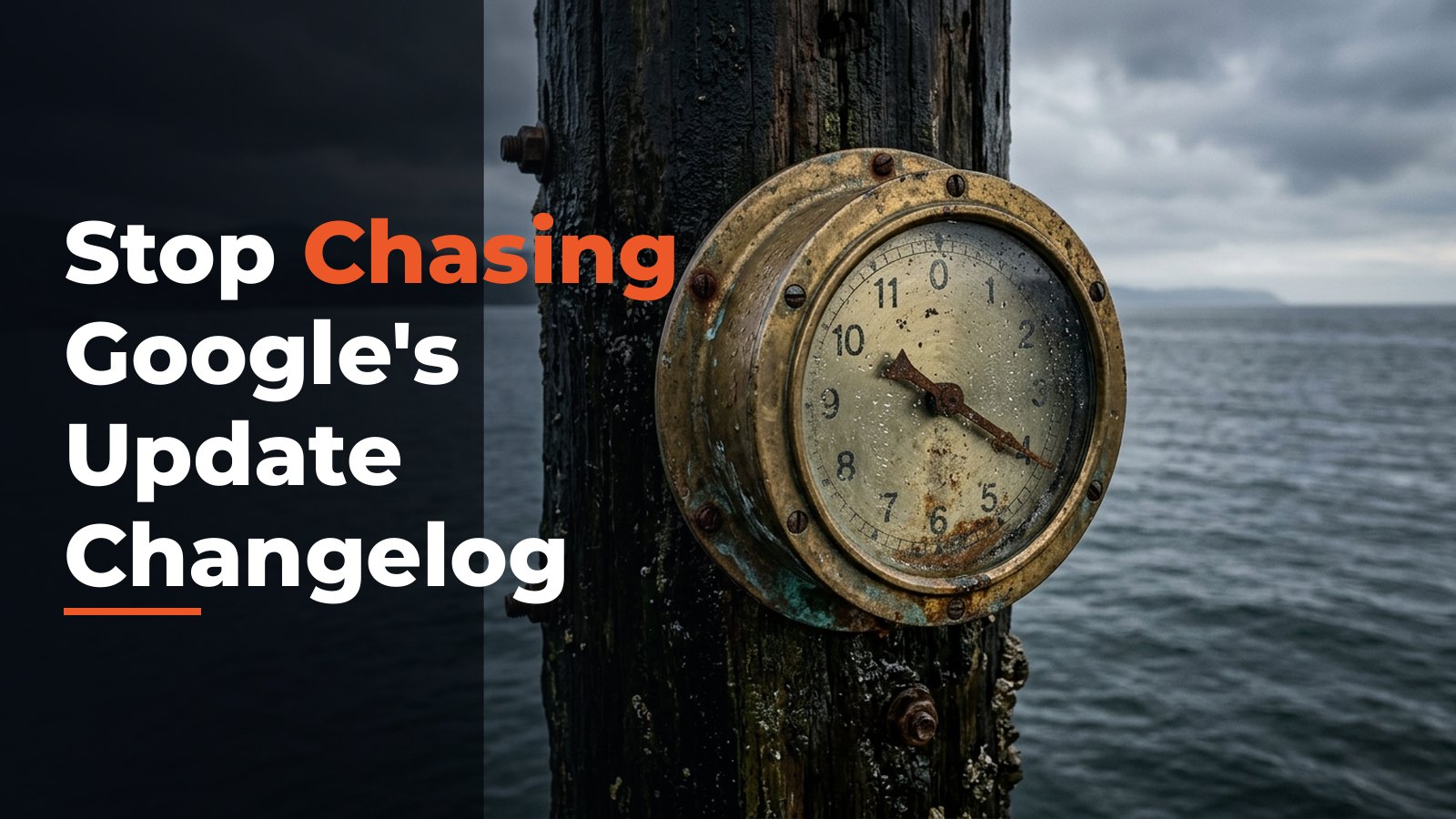
Because reacting to individual updates is like trying to understand the ocean by cataloging each wave. You can write down every one. You will still drown if you never notice the tide.
Reacting to every Google update is like studying the ocean one wave at a time while the tide quietly moves the entire shore.
A spam guide update about shareable pages is a wave. Restaurant ordering controls are a wave. A date field in a report is a wave. Individually, most of them do not change what you should do on Monday morning. They are maintenance. Google tunes its machine constantly, and most of that tuning is invisible to anyone who is just trying to run a good business with a useful website.
The mistake is not reading the news. The mistake is believing the news is the work.
Read the tide, not the wave
So what is the tide? What is the thing actually moving underneath all these scattered announcements?
Look at the mix of this week's updates again, but squint a little. Spam guidance about pages made for sharing. More structured control over how restaurant ordering shows up. Revenue appearing inside AI Mode. These do not look related on the surface. Underneath, they are telling you the same story.
Google is building a world where the answer happens on Google, and the money happens on Google too.
The spam guidance is Google deciding which content deserves to exist in that answer layer. The restaurant controls are Google turning a transaction into something it hosts and manages. The AI Mode revenue is Google figuring out how to get paid when the AI does the talking instead of a blue link.
That is the tide. The destination is slowly moving away from your website and toward Google's own surfaces. The waves are just the daily evidence of it.
That matters more than any single documentation change, because it tells you where your effort should go for the next three years, not the next three days.
The shareable pages note is the real tell
Of everything that moved this week, the spam update about indexing pages built to be shared is the one I would actually sit with. Not because it changes your technical setup much. Because of what it reveals about how Google is thinking.
Think about why a page gets made for sharing in the first place. A calculator. A free tool. A template. A genuinely useful resource somebody wants to send to a colleague. Google is signaling that it cares about how these things get indexed and whether they are the real thing or just bait wearing the costume of usefulness.
Read that as a warning and a map at the same time.
The warning is obvious. If you are spinning up thin pages that mimic the shape of helpful content, the window is closing, and it is closing faster inside AI systems than it ever did in classic search. An AI answer does not reward the tenth decent article on a topic. It picks sources it trusts and summarizes them. Being the tenth best is being invisible.
The map is the more interesting part.
In an AI answer there is no page two. There is the source that gets cited and there is everyone who does not exist.
The things people genuinely share are the things AI systems genuinely cite. A real tool. A clear piece of original thinking. A definition so good it becomes the standard. Those are the assets that survive the shift, because they are useful to a human and legible to a machine at the same time. The shareable pages note is Google quietly confirming that the useful stuff is the stuff that gets to keep existing.
AI Mode revenue is not the threat you think it is
When people see revenue showing up inside AI Mode, the reaction is usually dread. Google is going to keep the clicks. Google is going to keep the money. The open web is getting strip mined. I understand the feeling.
But let me push on it. What did you actually own before?
For twenty years we rented attention from Google and called it ownership. You ranked, you got traffic, you felt like the traffic was yours. It was never yours. It was a loan, renewed every day at Google's discretion, and the interest rate was whatever the latest core update decided it should be.
AI Mode making money does not take something away from you that you controlled. It makes visible a dependency that was always there. The question was never whether Google would monetize its own surfaces. Of course it would. The question is whether your business is built on being recommended or built on being clicked.
Those are not the same thing, and the difference is about to decide who makes it.
Being clicked versus being recommended
Here is the distinction I keep coming back to with clients, because it reframes the whole panic.
Being clicked is a traffic game. You show up in a list, you win the click, you hope the visitor does what you want. It is volume and it is fragile, because the list is owned by someone else and the rules of the list change without warning.
Being recommended is a trust game. When someone asks ChatGPT for the best option, or asks Google's AI to compare tools, or asks for a vendor in your category, you are either the name that comes up or you are not. There is no list to scroll. There is a recommendation, and it is short.
A hammer is not a house. Ranking for a keyword is a hammer. Being the brand an AI names when a buyer describes their problem is the house. Most marketers have spent a decade sharpening the hammer and almost no time building the house.
So how do you become recommendable? Not by chasing updates. By being the kind of entity these systems can understand and trust. That means a clear, consistent story about who you serve and what you are best at. It means real expertise published in plain language, not fog. It means being mentioned by other credible sources, because machines read the room the same way people do. It means your own site saying the same true thing everywhere, so there is no ambiguity about what you are.
None of that is in this week's changelog. All of it is in this week's tide.
What I would actually do with these updates
I am not telling you to ignore Google's announcements. I am telling you to demote them. Read them the way you read the weather, not the way you read a court summons. Useful context, rarely an emergency.
When an update lands, I ask three questions before I let anyone touch the roadmap.
- Does this change something a real customer experiences, or only something a report displays? Report date changes are housekeeping. Treat them like it.
- Does this reinforce the direction Google has been moving for years, or reverse it? If it reinforces, you already knew. If it reverses, now I am paying full attention.
- Would acting on this make us more useful to an actual human being, or just more compliant with a guideline? If the honest answer is only compliance, it goes to the bottom of the list.
Most updates fail all three tests. They are noise dressed up as news. The restaurant controls matter enormously if you run restaurants and mean nothing if you do not. The report date change matters to the person pulling the report and nobody else. The spam and AI revenue signals matter to everyone, because they describe the direction of the whole machine.
See the difference? The headline treats them as equal items in a list. They are not equal. One kind is weather. The other kind is climate.
The habit that actually compounds
I think the deeper problem with changelog chasing is what it does to your attention. It trains you to be reactive. To feel like marketing is a series of fires, and your job is to run between them with a bucket. That mindset feels responsible. It is actually the opposite, because it guarantees you never spend a full quarter building the thing that would make the fires stop mattering.
The brands that will be recommended by AI tools in two years are not the ones reading the fastest. They are the ones who decided what they wanted to be known for and then said it clearly, repeatedly, and credibly, for long enough that both humans and machines could not miss it.
That is boring. That is also why almost nobody does it.
The algorithm changes constantly. Being genuinely worth recommending does not go out of date.
So the next time an SEO update rolls across your feed and you feel that familiar jolt of pressure, slow down. Ask what it is really telling you about where Google is heading. Usually it is confirming something you already knew and quietly ignored.
Google is building a world where the useful thing gets recommended and everything else gets summarized out of existence. Every update this week said so in its own small way. You do not win that world by reading faster. You win it by being, without question, the thing worth naming.
Stop watching the waves. Learn the tide. Then go build something it cannot wash away.