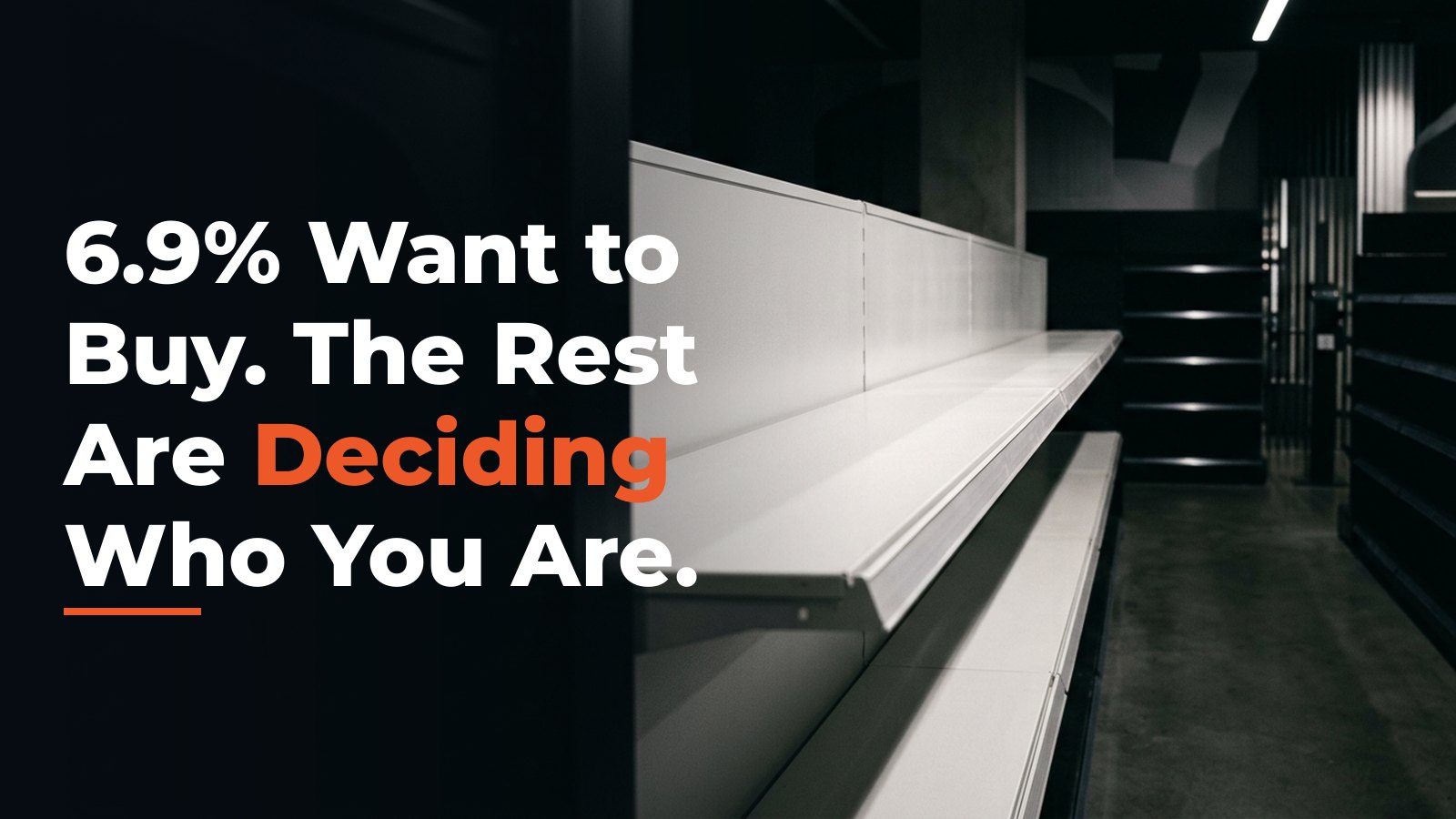
6.9% Want to Buy. The Rest Are Deciding Who You Are.
There is a comforting story going around right now, and a lot of smart people are telling it. The story is that ChatGPT is not really a sales channel, because a recent U.S. panel found that only 6.9% of conversations showed any intent to buy. Low number, low stakes, go back to what you were doing.
I want to pressure test that, because I think the people relaxing and the people panicking are making the exact same mistake. They are both reading one number and skipping the one that matters.
Here it is. In that same panel, most responses named no brand at all. Not yours. Not your competitor's. Nobody's.
A low purchase intent number tells you when people buy. A blank brand slot tells you whether they will ever think of you.
Those are two completely different questions. And the marketing world keeps answering the first one while quietly losing the second.
The number everyone will misread
6.9% sounds small. Compared to what, though?
That is the question nobody asks. If you walked into a store and watched a hundred people browse, you would not expect ninety three of them to walk to the register in the next five minutes. Most people in any space, physical or digital, are looking, not buying. They are forming impressions, narrowing options, building a short list in their head that they are not even aware they are building.
So a research tool showing 7% purchase intent is not a weak signal. It is a completely normal signal for a place where people go to think. ChatGPT is not a checkout line. It is closer to the conversation you have with a knowledgeable friend before you spend money. You do not ask your friend to ring you up. You ask them what they would do.
The mistake is treating a low conversion signal as proof that the channel does not matter. That is like dismissing a trade show because nobody signed a contract on the floor. The contract gets signed later, by the person who remembers who impressed them. Intent is where you harvest. It is not where the crop gets planted.
Demand capture is not demand creation, and AI blurred the line
For twenty years, search quietly trained marketers to be lazy about this distinction. Someone typed "best CRM for small teams" into Google, and we called that a bottom of funnel moment and bid on it. It felt like we were capturing intent. Really we were intercepting a decision that was mostly already made, and congratulating ourselves for the assist.
That worked because Google handed us the intent on a plate. The query was the proof. You could watch demand arrive and stick a landing page in front of it.
Here is what changed. A chat is not a query. When someone asks ChatGPT to help them think through a problem, there is no clean moment where "research" ends and "buying" begins. The whole conversation is the funnel, compressed into one window, moving in both directions at once. They ask a vague question, get an answer, change their mind, ask a sharper one. Somewhere in there a preference forms. Or it does not.
You cannot bid on that moment, because it is not a moment. It is a drift. And demand that drifts into existence is demand you created, not demand you captured.
Search let us pretend we were building demand when we were really just standing where it landed.
If 93% of these conversations are pre intent, then 93% of them are the part of the funnel we have always been worst at and most reluctant to pay for. The uncomfortable read on that 6.9% is not that AI does not sell. It is that AI is mostly made of the work we have been avoiding.
The empty room is the whole story
Go back to the detail everyone skips. Most responses named no brand.
Sit with how strange that is. These are often questions that beg for a recommendation. What should I use, where should I go, which one is worth it. And the machine, more often than not, answers in generics. It describes a category and names no one in it.
In search terms, that is a page one with no results. An entire aisle of unbranded shelf space. When a retailer finds an empty aisle in a high traffic store, they do not shrug and say demand is low. They ask why nothing is on the shelf and what it would take to be the thing that is.
A blank brand slot is not neutral. It is a vacancy with your name not on it. And unlike the ten blue links, where at least ten companies got mentioned, the AI answer often mentions zero. The distribution is brutal. A handful of names get recalled across millions of conversations, and everyone else is simply absent from the sentence.
That absence does not show up in a purchase intent metric. It shows up nowhere, which is exactly why it is dangerous. You can lose this quietly, for years, and your dashboard will never flinch.
Why purchase intent is a terrible yardstick for this
Metrics are tools, and a tool is only right for one job. A hammer is not a house. Purchase intent is a fine hammer for measuring a demand capture channel, because in a capture channel the intent and the outcome sit close together. You can draw a line.
Point that same hammer at a demand creation channel and it reports failure on everything that matters. It will tell you your brand sponsorship failed because nobody bought during the game. It will tell you the podcast ad failed because the promo code was quiet. It will tell you the trade show failed because the room did not convert. In each case the tool is working perfectly and answering the wrong question.
ChatGPT visibility is a demand creation surface wearing the costume of a search box. If you measure it by last click intent, you will conclude it does not work, you will pull your attention, and you will do that right as the habit of asking a machine "who is good at this" hardens into the default. The people who win here will not be the ones who proved ROI early. They will be the ones who showed up before there was anything to prove.
That is a deeply unfashionable thing to say in a quarter when everyone wants attribution on everything. I know. But the alternative is to only ever invest in the bottom of a funnel that fewer and fewer people enter through the top of.
The ad temptation, and the trap inside it
So here comes the pitch. If chats show purchase intent, even a little, then surely we should buy ads inside them. Put the brand in the answer. Pay to fill the empty room.
Slow down.
The reason the 6.9% matters to advertisers is obvious. It is the slice they can tie to a sale, so it is the slice they will pay to own. But think about what you are buying. You are buying placement in the one part of the conversation where the person is already decided, which is the least persuadable part. You are paying premium rates to show up to a decision you did not shape.
Meanwhile the 93% where the preference actually forms, the part no ad unit knows how to price yet, gets won by something that does not fit in an ad slot at all. It gets won by being the name the model has learned to associate with being good at the thing. That association is not bought in the chat. It is earned everywhere else the model reads. Reviews, press, forums, the plain consistent record of a company that keeps being described the same trustworthy way across the open web.
You can rent the 7% where people buy, or you can earn the 93% where they decide. Only one of those compounds.
I am not against the ads. I am against buying the ads as a substitute for being the kind of company a machine names unprompted. One is a cost you pay forever. The other is an asset you build once and keep.
The patience problem nobody wants to own
Here is why this is genuinely hard, and not just a matter of being clever.
Demand creation does not photograph well in a board meeting. You cannot put a crisp number next to it this quarter. The whole value of being the brand that gets named before intent exists is that it pays off later, to someone you will never be able to fully attribute. The customer who bought because, months ago, a chat mentioned you in passing and the name stuck, will tell you they found you through search. They are not lying. They just cannot see their own funnel any better than you can.
So the measurable channel always wins the budget fight against the meaningful one. That is not a new problem. AI just made it sharper, because it took the messy middle of the funnel, the research and the comparing and the asking around, and moved it somewhere you cannot instrument. You used to at least see the search queries. Now the deliberation happens inside a conversation you will never read, and all you get back is whether your name was in it.
The teams that will struggle are the ones who need the number before they will act. The teams that will win are the ones who understand that an empty brand slot is a standing invitation, and that invitations expire.
What the 6.9% is actually telling you
Read the panel the honest way. It is not saying ChatGPT does not sell. It is saying almost nobody who uses it is ready to buy in the moment, and almost nobody is hearing a brand name while they get ready.
That is not a reason to leave. That is a description of an open field.
The purchase intent number is the part of the story that will fit on a slide, so it is the part that will get quoted and the part that will get acted on. The blank brand slot is the part that will quietly decide who gets bought from two years from now, and it will do it whether or not anyone is watching.
Measure the 6.9% if you want to know what is happening today. Go win the other 93% if you want to still be in the sentence tomorrow.