
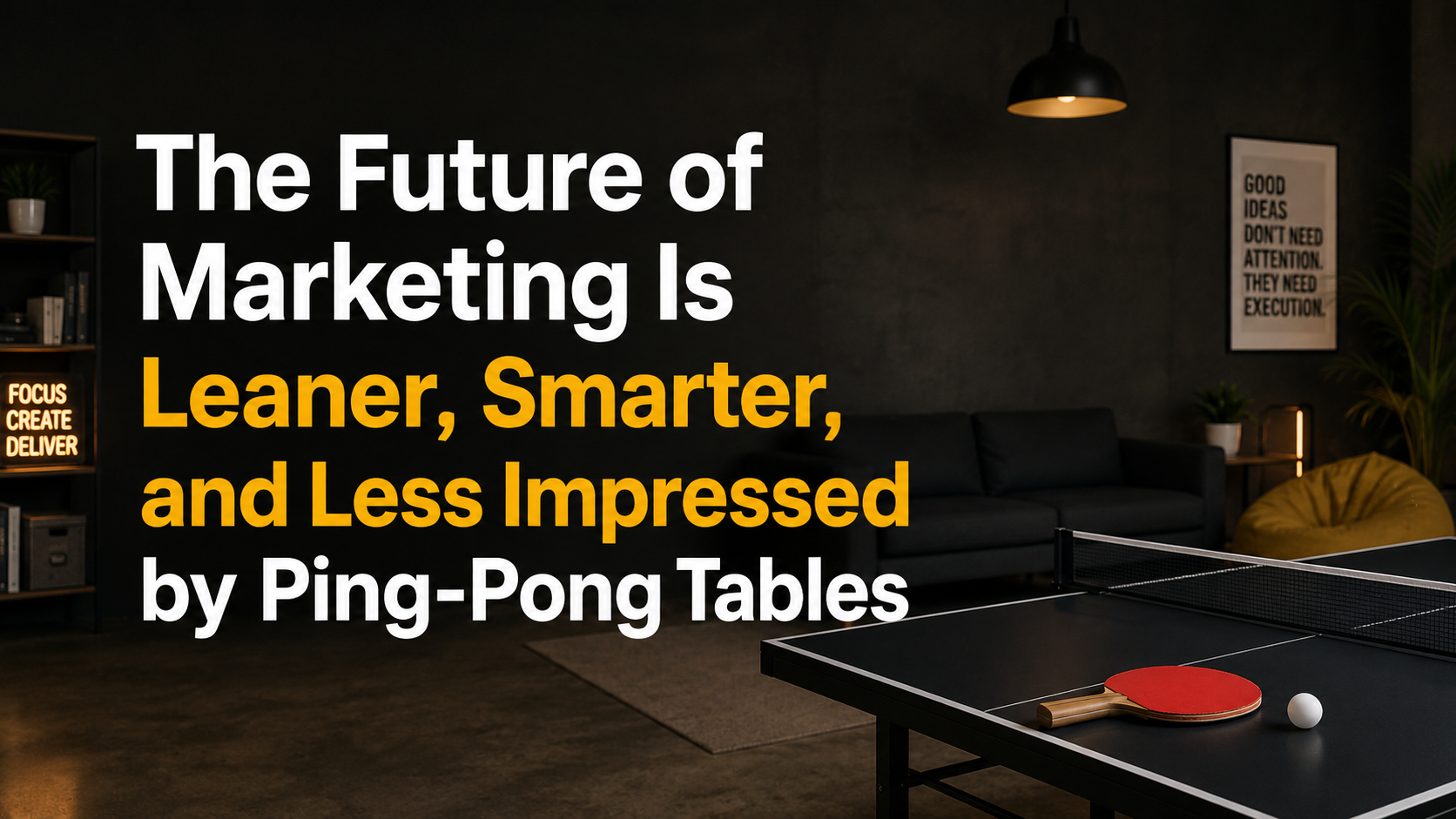
The Future of Marketing Is Leaner, Smarter, and Less Impressed by Ping Pong Tables
For decades, marketing and advertising had a look.
A group of creative people sitting in a room. Someone sipping scotch. Someone smoking a cigarette. A half written tagline on the board. A dramatic pause. Then suddenly, the big idea lands.
Boom! Campaign solved.
That image has been fed to us for years through movies, television, and the old Mad Men version of the advertising world. The job looked cool, clever, chaotic, and glamorous. Just a few brilliant people sitting around until the perfect line magically appeared.
But that was never the whole truth.
Great marketing has never been just a tagline. It has never been just a clever campaign idea. And it definitely has never been just a cool office full of foosball tables, exposed brick, and creative slogans painted on the wall.
The real work happens before the creative ever gets made.
It happens in the research.
The data.
The audience understanding. The positioning.
The data.
The strategy.
The testing. Did I mention data?
It's about answering the uncomfortable questions about what is actually working.
Creativity still matters. A lot.
But creativity without strategy is just decoration.
And businesses of all sizes are starting to ask a better question: Are we paying for real, strategic marketing, or are we paying for the performance of creativity?
Because those are not always the same thing.
The marketing world has changed. The way people work has changed. The tools available to marketers have changed. And the expectations from business owners have changed.
So maybe the agency model should change too.

The Old Agency Model Was Built for a Different Time
Traditional agencies were built around physical presence.
Everyone in the same office. Teams grouped by department. Big brainstorms in big rooms. Layers of account managers, creative directors, designers, strategists, copywriters, media buyers, project managers, and leadership.
That structure made sense when collaboration had to happen in-person and production required more manual labor.
But that model also created a lot of overhead:
• Expensive office space
• Large internal teams
• Multiple layers of communication
• Longer timelines
• More meetings
• More process
• More cost passed on to the client
None of that is automatically bad. Big agencies can do excellent work.
But for many small and medium businesses, that model can become expensive very quickly. And sometimes, what the client is really paying for is not better thinking. It is the cost of maintaining the machine.
The office.
The layers.
The infrastructure.
The image.
At some point, business owners have to ask:
Is this structure helping my marketing perform better, or am I funding someone else’s overhead?

The Myth of the Genius Tagline
There is a romantic version of advertising that makes it seem like the entire job is coming up with one unforgettable line.
Get the tagline right, launch the campaign, pour another drink, light another cigarette, and call it a day.
That makes for good television. It does not make for good marketing.
A strong tagline or campaign concept is usually the final expression of a much deeper process. Before you ever get to the creative idea, you need to understand:
• Who the customer is
• What problem they actually care about
• What alternatives they are considering
• Why they hesitate
• What language they use
• What channels influence them
• What data shows about their behavior
• What message will actually move them to act
That is the part most people do not see.
The creative output might be the headline, the ad, the video, or the website copy. But the value is in the thinking behind it.
The best marketing is not just creative.
It is informed creativity.
It is creativity shaped by research, sharpened by data, and focused on a business outcome.
That is a very different thing from sitting in a room waiting for lightning to strike.

Creativity Does Not Need a Cubicle
There is still a strange belief that creative work only happens when everyone is physically in the same place.
But anyone who has ever had a good idea in the shower, on a walk, while driving, or at 10:47 p.m. while trying to fall asleep knows that is not how creativity works.
Creativity is not always clean. It is not always scheduled. It does not always show up because there is a whiteboard and a meeting invite.
Sometimes creative thinking needs space.
It needs flexibility.
It needs quiet.
It needs movement.
It needs time away from forced collaboration.
That does not mean teamwork is unimportant. It means modern collaboration does not have to be tied to an office.
A remote or flexible agency model can still be highly strategic, highly creative, and highly accountable. In some cases, it can be better because people are not being forced into a rigid environment just to look productive.
The goal is not to make work look busy.
The goal is to produce strong thinking and great execution.

Research and Data Are the New Creative Fuel
The modern marketing process is not less creative than it used to be. It is more informed.
Today, strong marketing starts with evidence:
• Search behavior
• Website analytics
• Customer interviews
• Sales feedback
• Competitor positioning
• Ad performance
• Conversion data
• Audience behavior
• CRM insights
• Social engagement patterns
This is where the real advantage comes from.
The creative idea still matters, but it should not come out of nowhere. It should come from what the research is telling you.
If the data shows that customers are confused by your offer, the answer may not be “make a prettier ad.”
It may be “fix the message.”
If your website traffic is strong but conversions are weak, the answer may not be “drive more traffic.”
It may be “make the value proposition clearer.”
If your social content gets attention but produces no leads, the answer may not be “post more.”
It may be “rethink the audience and call to action.”
This is why modern marketing requires more than cleverness.
It requires curiosity, discipline, and the willingness to let the data challenge your assumptions.
The best creative teams do not ignore data.
They use it to make better creative decisions.
The Rise of the Lean Creative Team
A lean agency does not mean a lesser agency.
It means a focused one.
Instead of building around headcount, office space, and layers of process, lean creative teams are built around the actual work:
• Strategy
• Messaging
• Design
• Content
• Paid media
• SEO
• Video
• Analytics
• Reporting
• Execution
The right people can be brought into the right project at the right time.
That gives small and medium businesses access to specialized talent without having to pay for an entire full time team sitting under one roof.
It also removes a lot of unnecessary friction.
Fewer handoffs.
Faster communication.
More direct accountability.
Less “let me check with the team.”
More “here is what we recommend and why.”
For business owners, that matters.
You do not need a bloated process. You need clear thinking, smart execution, and a partner who can move with your business.
AI Should Accelerate the Thinking, Not Replace It
AI now adds another layer to this shift.
But let’s be clear: AI is not the new Don Draper.
It is not sitting in the corner generating the perfect campaign while everyone else nods in awe.
AI is a tool. A powerful one, but still a tool.
Used poorly, it creates generic marketing at scale. More words. More posts. More noise.
Used wisely, it helps experienced marketers move faster through the parts of the process that used to take too long:
• Organizing research
• Summarizing customer insights
• Comparing messaging angles
• Structuring campaign ideas
• Drafting outlines
• Refining copy
• Turning scattered thoughts into usable direction
• Speeding up repetitive tasks
That means clients should not have to pay for bloated hours when technology can help streamline the process.
But the human work still matters most.
Strategy still requires judgment.
Creative still requires taste.
Messaging still requires empathy.
Positioning still requires experience.
And someone still has to know whether the work is actually good.
AI can help shape the thinking.
It should not replace the thinker.
What This Means for Small and Medium Businesses
If you run or help lead a growing business, the agency landscape can be confusing.
You may not have the budget for a large traditional agency.
You may not need a full internal marketing department.
You may have tried freelancers and found the work inconsistent.
You may know marketing matters, but not know how much structure you actually need.
This is where the newer agency model becomes valuable.
Small and medium businesses need partners who can offer:
• Strategy without enterprise pricing
• Creative without inflated production timelines
• Execution without unnecessary complexity
• AI support without losing the human point of view
• Flexibility without sacrificing accountability
• Senior thinking without layers of overhead
In other words, you need a marketing partner built for how business works now.
Not how agencies worked twenty years ago.

The Future Is Not Bigger. It Is Smarter.
The future of marketing is not about who has the biggest office, the flashiest conference room, or the coolest mural on the wall.
It is about who can understand the business problem, build the right strategy, use the right tools, and execute with clarity.
That requires a different kind of agency mindset.
One that is:
• Lean
• Flexible
• Strategic
• Technology aware
• Creatively sharp
• Outcome focused
• Honest about what matters
Because the best marketing does not come from looking creative.
It comes from thinking clearly.
What Businesses Should Look for in a Modern Marketing Partner
If you are evaluating agencies or marketing partners, look beyond the surface.
Do not just ask:
“Do they have a nice portfolio?”
Ask:
• Do they understand our business model?
• Can they explain their strategy clearly?
• Are they focused on outcomes or activity?
• Do they know how to use AI responsibly?
• Are we paying for value or overhead?
• Will we have direct access to strategic thinking?
• Can they move quickly without becoming chaotic?
• Do they bring clarity, or do they add complexity?
A good agency should not make marketing feel more confusing.
It should make it easier to understand what matters and what to do next.
The Ping Pong Table Was Never the Point
There is nothing wrong with a fun office. There is nothing wrong with a creative space. And there is nothing wrong with traditional agencies that do great work.
But the office was never the value.
The value is the thinking.
The strategy.
The creativity.
The execution.
The trust.
The results.
Small and medium businesses should not have to pay for the image of innovation.
They should be able to partner with teams that actually help them grow.
The agency of the future will not be defined by where people sit.
It will be defined by how clearly they think, how well they collaborate, how wisely they use technology, and how effectively they help businesses move forward.
And no ping pong table can do that for you.
Final Thought (Thanks for reading this far. I didn't anticipate writing so much.)
The old image of marketing was built around the room.
The boardroom.
The brainstorm room.
The office with the clever walls and the “creative energy.”
But the future of marketing is not about the room.
It is about the rigor.
The research, the data, the strategy, the creative judgment, the technology, and the ability to turn all of that into marketing that actually works.
The businesses that win will not necessarily be the ones with the biggest agency or the biggest budget.
They will be the ones with the clearest strategy, the strongest message, and the right people using the right tools in the right way.
Lean does not mean less capable.
Remote does not mean less creative.
AI assisted does not mean less human.
And modern marketing does not need to perform creativity.
It needs to produce results.